This article was migrated from our previous website and, due to its age, some content, images, links, or details may be incomplete or unavailable.
For general inquiries, please contact info@cfig.ca. For questions regarding press releases or media content, please contact marketing@cfig.ca.
What you need to know about Step 3 of the BC Restart
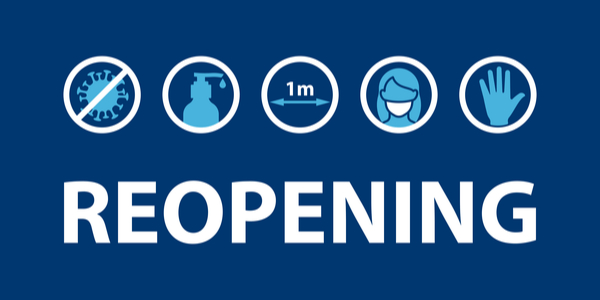
As British Columbia enters Step 3 of the Restart, the Provincial Health Officer has noted that businesses will no longer need to maintain a COVID-19 Safety Plan. In place of the COVID-19 Safety Plan, businesses are required to develop a communicable disease plan with appropriate measures to keep staff and customers safe (see Resources at the bottom of the email).
Regardless of the removal of COVID-19 Safety Plans, the PHO highly recommends that businesses consider keeping controls that reduce risk without significant impact to business operations.
In place of a formal COVID-19 plan, businesses must ensure that they are addressing all communicable diseases with appropriate measures. Implementing these measures is part of the general duties of an employer (Workers Compensation Act Section 21).
Businesses should review safety policies and programs. Have they covered the key “Reduce your risk” factors below? Businesses existing policies may already address factors such as air quality, hygiene facilities, and respiratory protection. If businesses have these measures in place, it is not necessary to document them in a formal written communicable disease plan nor does a business require approval to move forward with Stage 3.
Businesses can reduce their risk by
| Knowing the risks | Check weekly for Public Health Alerts Review any updates from your health region |
| Reducing the risks | At all times, maintain your communicable disease plan: Ensure a supportive sick leave policy Maintain hand hygiene (facilities, supplies, policy, signage) Ensure routine cleaning processes Ensure adequate ventilation Encourage staff vaccination When risk level is high: Follow orders from your regional medical health officer Follow industry- or region-specific provincial health orders Follow COVID-19 protocols as appropriate |
| Communicate | Provide signage and materials to workers and customers in a language they understand Seek advice on privacy and policy issues as needed Make sure all workers: Understand the new measures in place Know your sick-leave and work-from-home policies |
| Monitor | Supervise according to your new measures and continue to monitor: Use workplace inspections to ensure measures are working and followed Continue to monitor guidance Monitor your workplace and overall risk level Note changes in your workplace (processes, staff, premises) Make sure staff know how to raise health and safety concerns Involve your health and safety representative in identifying and resolving safety issues Adjust your plan as needed |
What does this mean for your stakeholders
Farmers or food processors employing or housing workers including temporary foreign workers – At this time, our understanding is that the industrial camps order will continue to stay in place in addition to the mandatory two week quarantine requirement for all workers entering the country (regardless of vaccination status). Employers must continue to ensure COVID-19 health and safety measures are maintained on farm and in-housing. AFF will continue to work with the PHO, WALI and Ag Safe to ensure plans are in place to support the health and safety of your farm and your staff. Please ensure you continue to review the Temporary Foreign Workers webpage as well as the PHO Orders and Guidance. We will continue to update you as soon as we have information about any changes to the Industrial Camps Order.
Farmers markets – You can increase capacity at the farmers market to normal levels so long as you have a communicable disease plan in place. It is encouraged that farmers markets (among others) continue to keep in place COVID-19 precautions that do not impact business operations.
Agricultural fairs or exhibitions – You can re-open on or after July 1st. You must have a communicable disease plan in place and continue to monitor guidance and orders as listed by the Provincial Health Officer. We are currently working to confirm whether fairs are able to open at full capacity of if they must abide by the capacity limits noted in the recent press release: The maximum capacity for indoor organized gatherings of 50 people or up to 50% of a venue’s total capacity, whichever is greater; and the maximum capacity for outdoor organized gatherings of 5,000 people or up to 50% of a venue’s total capacity, whichever is greater.
Food and liquor serving premises (restaurant, winery, brewery, cidery, etc.) – Hospitality establishments are encouraged to use this time as a transition period to ensure a safe reopening. Some measures are encouraged to stay in place such as barriers. People still cannot move between tables however the restriction of number of people at the tables have been removed. The use of long-tables or communal tables is allowed. Hours of service for liquor will now resort back to the approved license. Please be sure to review the Food and Liquor Serving Premises Order on the PHO webpage for updates. For restrictions on private events in such establishments including weddings and concerts, please review the Gathering and Events Order for updates.
Food retailers and grocery stores – Capacity limits, formal health screening tests and directional arrows, as well as other physical distancing measures will no longer be required. However, they may still be used during this transition period.
For all groups: masks continue to be recommended for all individuals over the age of 12 who are not fully vaccinated. For employers interested in the disclosure of vaccine status, it is highly recommended that they receive an independent legal opinion. For example, see ABLE BC.
Important to remember
Note that in cases of elevated risk, a medical health officer or the provincial health officer may direct employers in a specific region, industry, or workplace to undertake certain precautions such as the implementation of occupancy limits.
On July 10, 2020, the COVID-19 Related Measures Act came into force, enabling provisions created for citizens and businesses in response to the COVID-19 pandemic to continue as needed after the end of the provincial state of emergency. Under the provisions of this act, police and other enforcement officials will continue to be able to issue tickets for anyone who is contravening the Gatherings and Events or Food and Liquor Premises public health orders, which will remain in place. This includes fines for people who are being abusive or belligerent about the requirements of public health orders.
Resources to support employers
- B.C. Restart Plan
- Communicable Disease Prevention: A Guide for Employers
- Provincial Health Officer Orders and Guidance (Guidance updated on June 30th)
- B.C. CDC
- Temporary Foreign Workers
- COVID-19 Paid Sick Leave